

Kathryn Lerch
Before a crane goes up on a job site, someone asks for a certificate of insurance. Same before a stage gets built for a concert, a tenant signs a lease, or a shipment leaves port. The general contractor wants proof the sub is covered. The venue wants proof the promoter is covered. The landlord, the lender and the shipper all want the same thing, on one page, before any work starts.
That page is the COI, and a surprising amount of the economy waits on it. Deals don't close and crews don't get on site until it shows up.
Every certificate lands on an agency's desk
Every one of those requests ends up with an account manager at an insurance agency, and it usually shows up as urgent. The work can't start until the certificate exists, so the client is waiting and so is everyone behind them.
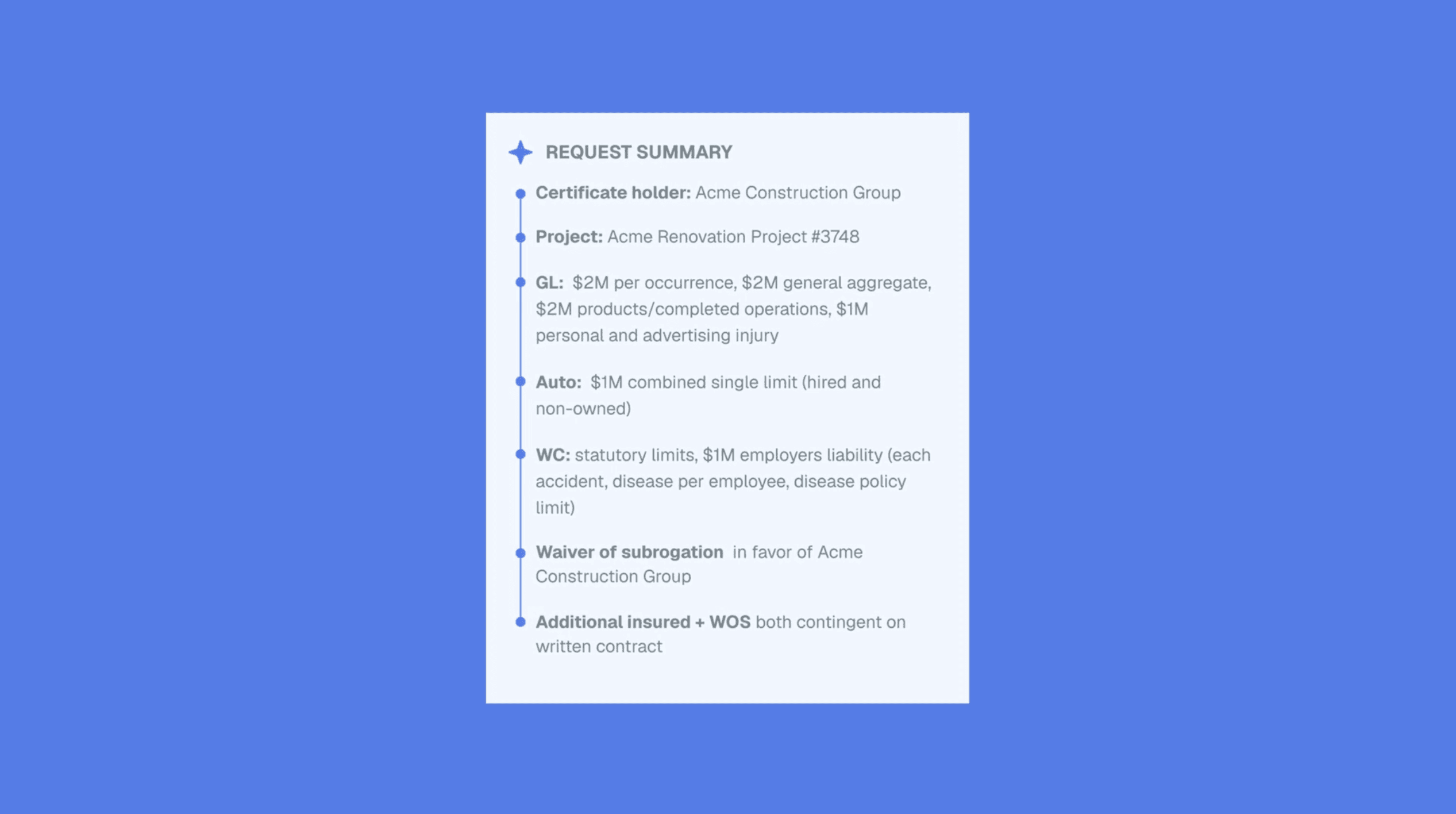
The document looks simple, but the AM has to get a lot right to produce it. They work out what the certificate holder requires: which coverages, what limits, whether they need additional insured status, waiver of subrogation, or primary and non-contributory wording. They confirm the client's policies actually provide all of it. They find the endorsements that prove it, which can be buried on page 140 of a 200-page policy. Then they write a description of operations that's accurate for the project and doesn't promise coverage that isn't there.
Getting it wrong is expensive. A certificate that overstates coverage is an E&O exposure for the agency. Now add hundreds of requests a month, plus the renewal season when every certificate has to be reissued at once. When we talk to service teams about certificates, the words we hear most are "tedious" and "painstaking."
Built for the volume and the stakes

Fulcrum Certificates takes on that work from start to finish. The account manager forwards the request email, and Fulcrum sends back a completed certificate, usually in under a minute.
Between the forward and the finished certificate, Fulcrum does five things:
Reads the request. Fulcrum works out what coverage the holder requires and checks it against the client's actual policies.
Applies the right template. It picks the template from audited coverage lines and the relevant named insured.
Pulls endorsements from the policy. Forms and attachments come straight from the account's policies, which serve as the source of truth. Fulcrum finds the required endorsements inside long policy documents and attaches them to the certificate.
Fills in the description of operations. Project details, additional insureds and endorsement language go in, using the wording your legal team has approved.
Handles renewals in bulk. Renewal certificates go out as a batch in a few clicks.
Because every certificate is built from the policies themselves, accuracy doesn't depend on someone finding the right page at 6 p.m. on a Friday. With certificates off their plate, account managers get their time back for clients. New hires also get up to speed faster, since they don't have to learn a maze of templates first.
Beyond certificates
Certificates are one of many workflows Fulcrum runs across the brokerage account lifecycle. Across commercial and personal lines, that includes proposals, policy checking, gap analysis, broker of record letters, workers' comp audits and claims denial challenges. Agencies set Fulcrum up around the work that takes the most of their team's time. For a lot of them, that starts with certificates.
See Fulcrum Certificates in action at withfulcrum.com.